Recovery & Equipment
Recovery Equipment After Foot or Ankle Surgery: What Works
By KC Mobility Scooter Rentals · · Updated
Surgeons hand you crutches at discharge and expect you to figure out the rest. The crutches handle the first 48 hours. After that, most people are exhausted, behind on basic tasks, and asking the wrong question — “is there a better crutch?” — when the right question is “what should I be using instead?”
Foot and ankle recovery is non-weight-bearing for two to six weeks for most procedures. The right recovery equipment depends on how long you’ll be off the foot, how mobile you need to be, and what your home environment looks like.
The quick answer
For non-weight-bearing recovery longer than a week with mostly hard floors at home, a knee scooter is the right primary device. For multi-story homes or stair-heavy environments, add or substitute a transport chair. Crutches stay in the picture for short distances and stairs but should not be your only mobility tool past day five.
The biggest mistake: trying to handle a six-week recovery on crutches alone because nobody told you there was anything else.
Equipment options for foot and ankle recovery
Five categories of equipment do most of the work in foot and ankle recovery. Each has a clear use case.
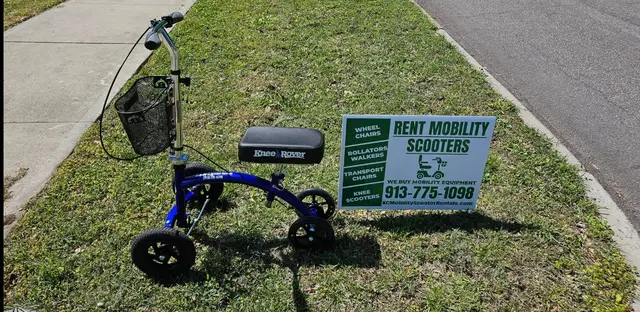
Knee scooter (also called a knee walker). A wheeled device with a padded platform for the injured leg’s knee. The user stands on the good leg and rolls. Hands are free when stopped. The dominant choice for non-weight-bearing recoveries longer than a week. Indoor and smooth-outdoor surfaces only — does not handle stairs, gravel, or grass. Rents for $50/week or $100/month (weekly/monthly only — no daily rate) in the Kansas City metro. See knee scooter vs crutches for the comparison most patients actually need, knee scooter vs knee walker for the naming question, and how to use a knee scooter for the technique.
Crutches. Pair of underarm or forearm supports. Required at hospital discharge in most cases. Handle stairs and short distances well. Cause secondary injuries (palm calluses, ulnar nerve compression, rotator-cuff inflammation) when used as the only device for more than a week. Free at most hospital discharges or $20–40 to buy.
Transport chair. Lightweight (under 20 lb) wheelchair pushed by a companion. Right answer for visits outside the home (doctor appointments, family events, longer outings) when fatigue from a knee scooter or crutches is the limiting factor. One-person lift over short stairs. Rents at the same tier as a knee scooter.
Manual wheelchair. Heavier (35–40 lb) self-propellable chair. Fit for home daily use during longer recoveries (8+ weeks of non-weight-bearing) when the user prefers self-propulsion or where the home is large enough that a chair is more practical than a knee scooter for some tasks.
Rollator. A wheeled walker with hand brakes and a seat. Right answer for the transition phase after a non-weight-bearing window ends and partial-weight-bearing begins. Most surgeons clear patients to a rollator around weeks 4–6 of foot surgery recoveries.
What’s not on this list: Electric or power wheelchairs, scooters as a primary recovery device. Mobility scooters are visit-and-distance tools, not home recovery devices — the rider needs to stand and pivot to transfer in and out, which conflicts with the non-weight-bearing protocol. Knee scooters serve the recovery use case better. For why a wheelchair is sometimes the right call instead of a knee scooter, see knee scooter vs wheelchair. For knee/hip recoveries (which need a different equipment plan entirely), see recovery equipment after knee or hip surgery.
Matching equipment to recovery type
Different procedures imply different equipment patterns.
Bunionectomy, hammertoe correction, plantar fascia release, metatarsal repair. Typical non-weight-bearing window: 2–4 weeks, then partial-weight-bearing in a boot. Equipment plan: crutches for the first 48 hours, knee scooter for weeks 1–4, transition to walking boot and rollator (or unaided walking) at week 4–6.
Ankle reconstruction, ankle fracture ORIF. Typical non-weight-bearing window: 6–8 weeks. Equipment plan: crutches at discharge, knee scooter for the bulk of the recovery, manual wheelchair for any extended time off your feet (long days, fatigue), transport chair for outings, rollator for the partial-weight-bearing transition.
Achilles repair. Typical non-weight-bearing window: 4–6 weeks, with a boot wedge or cast immobilizing the ankle in plantar flexion. Knee scooters work but the cast or boot may interfere with knee positioning on the platform — fit becomes critical. Transport chair as a backup for fatigue.
Broken foot or ankle (non-surgical). Casting or boot, with non-weight-bearing or partial-weight-bearing depending on the fracture. Equipment plan similar to bunionectomy: crutches plus knee scooter, with rollator at the transition.
Hospital-discharge recovery from non-foot procedures (bed rest, deconditioning, hip replacement) where ambulation is limited but a foot is fine. Wheelchair (manual or transport chair) plus rollator for transition. Knee scooter is the wrong tool here — it requires standing on one leg, which deconditioned patients can’t reliably do.
When you actually need the equipment
The most common timing pattern that works:
- Day 0–2 (post-op): crutches at discharge. Most movement is bed-to-bathroom-to-couch.
- Day 3–7: crutches still, but exhaustion sets in. This is the window where a knee scooter delivery makes the biggest single quality-of-life difference.
- Week 2–4: knee scooter daily, transport chair for any longer outings if available, crutches still nearby for stairs.
- Week 4–6: transition to walking boot, possibly graduating to a rollator.
- Week 6–8+: rollator or unaided walking, depending on the procedure and your specific recovery.
Most people order their knee scooter rental between day 3 and day 5 — the moment it becomes clear that crutches alone are not going to work for the full recovery. Ordering on day 0 or day 1 is reasonable too if your surgeon has told you the non-weight-bearing window is two weeks or longer; it gives you the first 24 hours to settle into being home before the device arrives.
We do same-day delivery in the Kansas City metro for orders placed before 2 p.m., zone-based delivery fee starting at $25 within 10 miles of our Leavenworth base.
What we recommend renting (most KC recoveries)
The standard recovery rental package, priced for 4-week-or-less recoveries:
- Primary device: knee scooter. $100/month, the most cost-effective single device for the recovery.
- Optional add-on for outings: transport chair. Add for the specific weekend you have a doctor appointment, family event, or longer outing where the knee scooter would tire you. Rent for a single day or weekend rather than the full month.
- Crutches: keep the hospital discharge pair. They’re the stair tool.
- Rollator: add at week 4 if you’re cleared to partial-weight-bearing.
For longer recoveries (6+ weeks of non-weight-bearing), consider:
- Knee scooter monthly rental for the bulk of the recovery.
- Manual wheelchair for home use if the knee scooter alone is fatiguing — some users alternate, knee scooter for short trips, wheelchair for longer in-home distances.
- Transport chair on-call for outings.
Ready to reserve your equipment?
Reserve online at kcmobilityscooterrentals.com/reserve or call 913-775-1098.
- Hospitality rental — no medical paperwork
- Same-day delivery in the KC metro
- Hotel & home delivery available
- Serving Bartle Hall, Arrowhead, OPCC, the Plaza & 20+ KC venues
Frequently Asked Questions
How long after foot surgery do most people need a knee scooter?
Can I use a knee scooter on stairs?
What if my home has carpet?
Will my insurance cover any of this?
Can I rent a knee scooter from a Kansas City pharmacy?
Related Guides
- Knee Scooter vs CrutchesThe honest comparison for non-weight-bearing recovery.
- Best Knee Scooter for Foot SurgeryFeatures that matter for a 2–6 week recovery.
- How to Use a Knee ScooterSetup, technique, and avoiding the day-one fall.
- Knee Scooter vs WheelchairWhen wheelchair is the right call instead of knee scooter.
- Knee Scooter RentalSteerable knee scooters for foot and ankle recovery.
- Transport Chair RentalLightweight companion-pushed chair for outings.